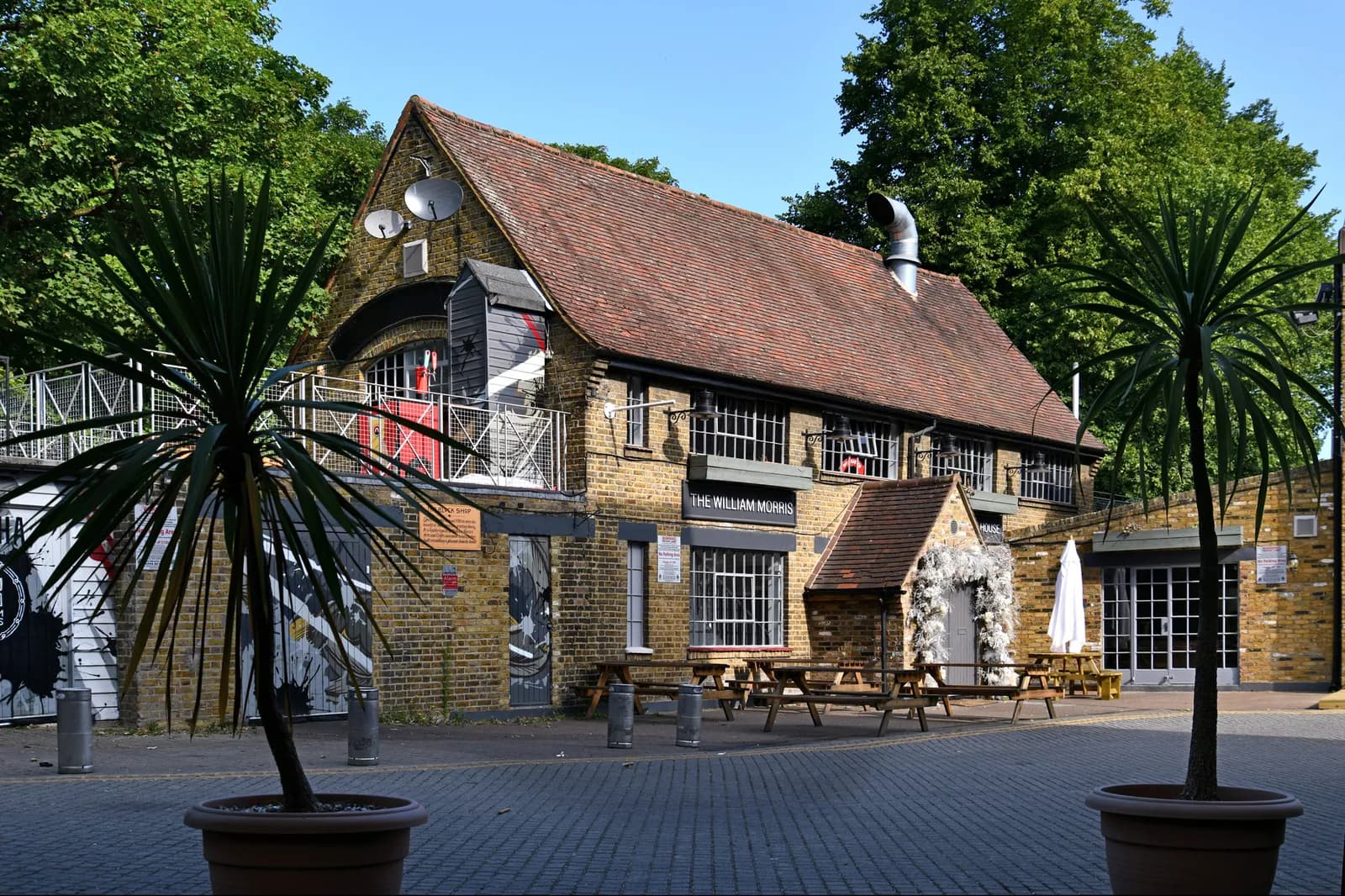
In 1881, William Morris moved his textile printing operations to a former 17th-century calico printing site in Merton. The works would become the principal production centre for Morris & Co. and a defining location in the British Arts and Crafts movement.
The Move to Merton
William Morris acquired the Merton Abbey Works site in 1881. The location had previously housed a calico printing works dating from the 17th century. Morris established his operations there the same year, consolidating the firm's textile printing activities at this riverside site in the London Borough of Merton.
The works remained the primary production site for Morris & Co. from 1881 until Morris's death in 1896. The firm continued operating there until 1940.
What Was Produced
Merton Abbey Works manufactured the full range of Morris & Co. products. These included printed textiles, woven fabrics, carpets, tapestries, embroidery, stained glass, furniture, and metalwork.
The site is particularly notable for the production of Morris's iconic "Strawberry Thief" textile design, first manufactured there in 1883. This pattern, depicting birds stealing strawberries in a garden, remains one of the most recognisable works of the Arts and Crafts movement.
The site also housed a dedicated glass furnace for producing stained glass commissions for churches and domestic clients.
The Arts and Crafts Movement
The Arts and Crafts movement emerged in Britain during the 1880s as a reaction against industrialisation and mass-produced goods. Its advocates championed traditional craftsmanship, simple forms, and medieval and romantic decorative styles.
William Morris is widely regarded as the founder and leading figure of this movement. At Merton Abbey, he sought to put these ideals into practice, balancing hand craft with the realities of industrial production.
Employment in Merton
The works provided significant local employment. At its peak in the 1890s, Merton Abbey Works employed up to 100 local people in skilled craft positions.
Local figure John Henry Dearle, a Merton resident, joined the works in 1878. He became Morris's chief assistant and later ran Morris & Co. until 1932, bridging the firm's founding and its later decades.
The Site Today
Merton Abbey Works holds Scheduled Monument status (Historic England entry 1002050), reflecting its national significance as a principal production centre for Morris & Co. and a key site integrating Arts and Crafts craft ideals with industrial processes.
Several historic structures survive on the site. These include the Grade II listed 18th-century Print Works (c.1720), the Grade II listed 19th-century Dye House (c.1850), the water wheel pit, leats, sluices, and the former glass furnace site.
The location is now redeveloped as Merton Abbey Mills, a public heritage site. It features craft workshops, a weekly market, the Watermill Museum, and regular Arts and Crafts events. The London Borough of Merton manages public access to the site.
The location occupies land that once held the medieval Merton Abbey, dissolved in 1538. This layered history spans from religious house to industrial works to contemporary heritage attraction.